
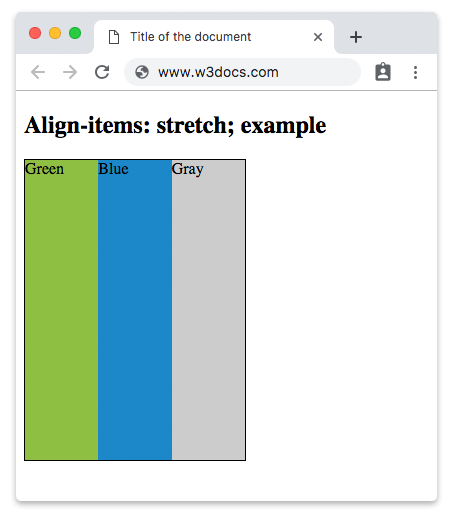
The CSS align-items property specifies the default alignment for flex items. It is similar to the justify-content property but the vertical version.
This property is one of the CSS3 properties.
The align-items property accepts the following values:
- stretch
- flex-start
- center
- flex-end
- baseline
| Initial Value | stretch |
| Applies to | All elements. |
| Inherited | No. |
| Animatable | No. |
| Version | CSS3 |
| DOM Syntax | object.style.alignItems = "center"; |
Syntax
align-items: stretch | center | flex-start | flex-end | baseline | initial | inherit;Example of the align-items property:
<!DOCTYPE html>
<html>
  <head>
    <title>Title of the document</title>
    <style>
      #example {
        width: 220px;
        height: 300px;
        padding: 0;
        border: 1px solid #000;
        display: -webkit-flex;
        /* Safari */
        -webkit-align-items: stretch;
        /* Safari 7.0+ */
        display: flex;
        align-items: stretch;
      }
      #example li {
        -webkit-flex: 1;
        /* Safari 6.1+ */
        flex: 1;
        list-style: none;
      }
    </style>
  </head>
  <body>
    <h2>Align-items: stretch; example</h2>
    <ul id="example">
      <li style="background-color:#8ebf42;">Green</li>
      <li style="background-color:#1c87c9;">Blue</li>
      <li style="background-color:#ccc;">Gray</li>
    </ul>
  </body>
</html>Result
In the following example, the items are positioned at the center of the container.
Example of the align-items property with the "center" value:
<!DOCTYPE html>
<html>
  <head>
    <title>The title of the document</title>
    <style>
      #example {
        width: 220px;
        height: 300px;
        padding: 0;
        border: 1px solid #000;
        display: -webkit-flex;
        /* Safari */
        -webkit-align-items: center;
        /* Safari 7.0+ */
        display: flex;
        align-items: center;
      }
      #example li {
        -webkit-flex: 1;
        /* Safari 6.1+ */
        flex: 1;
        list-style: none;
      }
    </style>
  </head>
  <body>
    <h2>Align-items: center; example</h2>
    <ul id="example">
      <li style="background-color:#8ebf42;">Green</li>
      <li style="background-color:#1c87c9;">Blue</li>
      <li style="background-color:#ccc;">Gray</li>
    </ul>
  </body>
</html>In the next example, the items are placed at the beginning.
Example of the align-items property with the "flex-start" value:
<!DOCTYPE html>
<html>
  <head>
    <title>The title of the document</title>
    <style>
      #example {
        width: 220px;
        height: 300px;
        padding: 0;
        border: 1px solid #000;
        display: -webkit-flex;
        /* Safari */
        -webkit-align-items: flex-start;
        /* Safari 7.0+ */
        display: flex;
        align-items: flex-start;
      }
      #example li {
        -webkit-flex: 1;
        /* Safari 6.1+ */
        flex: 1;
        list-style: none;
      }
    </style>
  </head>
  <body>
    <h2>Align-items: flex-start; example</h2>
    <ul id="example">
      <li style="background-color:#8ebf42;">Green</li>
      <li style="background-color:#1c87c9;">Blue</li>
      <li style="background-color:#ccc;">Gray</li>
    </ul>
  </body>
</html>Here, we apply the "flex-end" value which places the items at the end of the container.
Example of the align-items property with the "flex-end" value:
<!DOCTYPE html>
<html>
  <head>
    <title>The title of the document</title>
    <style>
      #example {
        width: 220px;
        height: 300px;
        padding: 0;
        border: 1px solid #000;
        display: -webkit-flex;
        /* Safari */
        -webkit-align-items: flex-end;
        /* Safari 7.0+ */
        display: flex;
        align-items: flex-end;
      }
      #example li {
        -webkit-flex: 1;
        /* Safari 6.1+ */
        flex: 1;
        list-style: none;
      }
    </style>
  </head>
  <body>
    <h2>Align-items: flex-end; example</h2>
    <ul id="example">
      <li style="background-color:#8ebf42;">Green</li>
      <li style="background-color:#1c87c9;">Blue</li>
      <li style="background-color:#ccc;">Gray</li>
    </ul>
  </body>
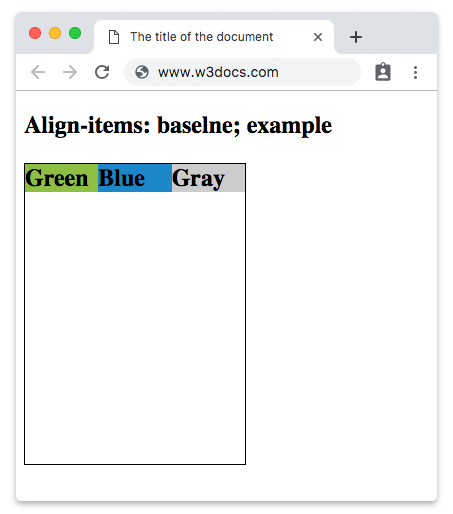
</html>Let’s see our last example with the "baseline" value which places the items at the baseline of the container.
Example of the align-items property with the "baseline" value:
<!DOCTYPE html>
<html>
  <head>
    <title>The title of the document</title>
    <style>
      #example {
        width: 220px;
        height: 300px;
        padding: 0;
        border: 1px solid #000;
        display: -webkit-flex;
        /* Safari */
        -webkit-align-items: baseline;
        /* Safari 7.0+ */
        display: flex;
        align-items: baseline;
      }
      #example li {
        -webkit-flex: 1;
        /* Safari 6.1+ */
        flex: 1;
        list-style: none;
      }
    </style>
  </head>
  <body>
    <h2>Align-items: baseline; example</h2>
    <ul id="example">
      <li style="background-color:#8ebf42;">Green</li>
      <li style="background-color:#1c87c9;">Blue</li>
      <li style="background-color:#ccc;">Gray</li>
    </ul>
  </body>
</html>Result
Values
| Value | Description | Play it |
|---|---|---|
| stretch | Makes items stretch to fit the container. This is the default value for this property. | Play it » |
| center | Items are placed at the center of the container. | Play it » |
| flex-start | Items are placed at the beginning of the container. | Play it » |
| flex-end | Items are placed at the end of the container. | Play it » |
| baseline | Items are positioned at the baseline of the container. | Play it » |
| initial | It makes the property use its default value. | Play it » |
| inherit | It inherits the property from its parents element. |
Browser support

|

|

|
|
|---|---|---|---|
|
29.0+ 21-28 -webkit- |
28.0+ |
9.0+ 6.1-8.0 -webkit- |
12.1+ |
Practice Your Knowledge
What are the possible values for the 'align-items' property in CSS?

Correct!

Incorrect!
Quiz Time: Test Your Skills!
Ready to challenge what you've learned? Dive into our interactive quizzes for a deeper understanding and a fun way to reinforce your knowledge.