
The HTML <rtc> element specifies semantic annotations of characters that are presented in <rb> elements used inside a <ruby>. The <rb> elements can have both semantic (<rtc>) and pronunciation (<rt>) annotations.
Ruby annotations are usually used in East Asian typography. Rubi characters are small, annotative characters that are placed above or to the right of a Chinese character to show the pronunciation.
The <rtc> tag is one of the HTML5 elements.
Syntax
The <rtc> tag comes in pairs. The content is written between the opening (<rtc>) and closing (</rtc>) tags. The closing tag of the <rtc> element may be omitted when
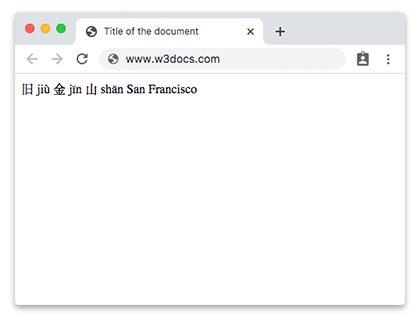
Example of the HTML <rtc> tag:
<!DOCTYPE html>
<html>
  <head>
    <title>Title of the document</title>
  </head>
  <body>
    <ruby>
      <rbc>
        <rb>旧</rb>
        <rt>jiù</rt>
        <rb>金</rb>
        <rt>jīn</rt>
        <rb>山</rb>
        <rt>shān</rt>
      </rbc>
      <rtc>San Francisco</rtc>
    </ruby>
  </body>
</html>Result
The <rtc> tag supports the Global Attributes and Event Attributes.
Browser support

|

|

|

|
|---|---|---|---|
| ✕ | 33.0+ | ✕ | ✕ |
Practice Your Knowledge


Quiz Time: Test Your Skills!
Ready to challenge what you've learned? Dive into our interactive quizzes for a deeper understanding and a fun way to reinforce your knowledge.